Euclidean Geometry
Introduction
Euclidean geometry forms the spatial reasoning foundation essential for machine learning. From understanding projections in high-dimensional spaces to grasping optimization landscapes, these concepts are fundamental prerequisites.
Axioms and Postulates
“The laws of nature are but the mathematical thoughts of God.” — Euclid
Motivation & Context
Historical Setting
In 3rd century BCE Alexandria, Euclid faced a challenge: how to organize all known geometry into a logical system? Rather than present thousands of disconnected facts, he identified a minimal set of self-evident truths from which everything else could be derived.
This revolutionary approach:
- Established the axiomatic method still used in mathematics
- Influenced formal logic and computer science
- Demonstrated that complex knowledge can be built from simple foundations
The Problem
Without axioms, we face infinite regress:
- To prove theorem A, we need theorem B
- To prove theorem B, we need theorem C
- To prove theorem C, we need theorem D…
- Where does it end?
Euclid’s solution: Start with statements so obvious they need no proof.
Modern Relevance
In ML/CS:
- Programming languages have axioms (basic operations)
- Formal verification systems use axiomatic foundations
- Type theory builds on logical axioms
- Probabilistic reasoning starts with probability axioms
Key Insight: Complex systems require foundational assumptions. The art is choosing the minimal sufficient set.
Intuitive Picture
Think of axioms as the “rules of the game” for geometry:
Point → GPS coordinate (location, no size)
Line → Stretched string (shortest path)
Plane → Infinite tabletop (flat surface)
Distance → Measuring tape result
Mental Model: You have an infinite blank canvas and two tools:
- Unmarked straightedge (draw lines)
- Compass (draw circles)
The axioms tell you:
- What operations are allowed
- What properties are guaranteed
- What you can assume without proof
Precise Definitions
Undefined Terms
Three concepts are primitive (undefined, but understood intuitively):
Point: An object with no dimensions (position only)
Line: A one-dimensional object extending infinitely in both directions
Plane: A two-dimensional flat surface extending infinitely
Why undefined? To avoid circular definitions. These are our starting vocabulary.
Euclid’s Five Postulates
Postulate 1 (Uniqueness of Line).
Given any two distinct points $P$ and $Q$, there exists exactly one line $\ell$ passing through both.
Postulate 2 (Line Extension).
Any line segment can be extended indefinitely in both directions to form a line.
Postulate 3 (Circle Construction).
Given any point $C$ (center) and any positive distance $r$ (radius), there exists a circle with center $C$ and radius $r$.
Postulate 4 (Right Angle Congruence).
All right angles are congruent to one another.
Postulate 5 (Parallel Postulate).
Given a line $\ell$ and a point $P$ not on $\ell$, there exists exactly one line through $P$ parallel to $\ell$.
Common Notions (Axioms of Equality)
CN1 (Transitivity). If $a = b$ and $b = c$, then $a = c$.
CN2 (Addition). If $a = b$ and $c = d$, then $a + c = b + d$.
CN3 (Subtraction). If $a = b$ and $c = d$, then $a - c = b - d$.
CN4 (Coincidence). Things that coincide are equal.
CN5 (Whole vs Part). The whole is greater than any proper part.
Why These Definitions
Why These Specific Five Postulates?
Postulates 1-4: Relatively “obvious”
- Can verify locally with physical tools
- Match immediate intuition
- Universally accepted
Postulate 5: Controversial!
- Cannot verify by direct observation (requires infinite extension)
- More complex statement
- Led to 2000 years of attempted proofs
Why Is Postulate 5 Special?
It’s the only postulate that:
- Requires infinity: Must extend lines infinitely to verify
- Determines curvature: Characterizes flat (Euclidean) space
- Is independent: Cannot be derived from Postulates 1-4
Historical Impact: Attempts to prove Postulate 5 from 1-4 ultimately led to:
- Hyperbolic geometry (Lobachevsky, Bolyai)
- Elliptic geometry (Riemann)
- General relativity (Einstein)
Why Axioms of Equality?
These establish logical consistency:
- Enable substitution in proofs
- Allow algebraic manipulation
- Provide ordering relations
Without them, we couldn’t reason about relationships between measurements.
Key Properties
From these axioms, immediate consequences follow:
Property 1 (Uniqueness). Given specific conditions, geometric objects are uniquely determined:
- Two points → one line
- Center + radius → one circle
- Line + external point → one parallel
Property 2 (Existence). Geometric objects can always be constructed:
- Lines can be drawn and extended
- Circles always exist for any radius
- Intersections occur (when not parallel)
Property 3 (Consistency). No contradictions arise:
- Equality is transitive and symmetric
- Measurements can be compared
- Whole > Part establishes order
Main Theorems
These axioms enable us to prove everything else:
Theorem 1.1 (Vertical Angles).
When two lines intersect, vertical angles are congruent.
Theorem 1.2 (Triangle Angle Sum).
The sum of interior angles in any triangle equals 180°.
Theorem 1.3 (SSS Congruence).
Triangles with three pairs of congruent sides are congruent.
Theorem 1.4 (Pythagorean Theorem).
In a right triangle: $a^2 + b^2 = c^2$.
Theorem 1.5 (Parallel Line Properties).
When a transversal crosses parallel lines, corresponding angles are congruent.
All of these follow logically from the five postulates!
Computational Methods
How to Use Axioms in Proofs
Standard Proof Structure:
Given: [What we know]
Prove: [What we want to show]
Proof:
  1. [Statement]     [Reason: Given/Axiom/Previous theorem]
  2. [Statement]     [Reason: ...]
  ...
  n. [Conclusion]    [Reason: ...]  ∎
Example: Prove base angles of isosceles triangle are equal.
Given: △ABC with AB = AC
Prove: ∠B = ∠C

Proof:
  1. Draw angle bisector AD from A to BC     [Construction]
  2. ∠BAD = ∠CAD                             [Definition of angle bisector]
  3. AB = AC                                  [Given]
  4. AD = AD                                  [Reflexive property]
  5. △ABD ≅ △ACD                             [SAS congruence]
  6. ∠B = ∠C                                  [CPCTC]  ∎
Verification Algorithm
To check if a proof is valid:
def verify_proof(proof_steps):
    """
    Verify each step cites proper justification.

    Returns: True if valid, False otherwise
    """
    known_facts = set(['given_facts', 'axioms', 'postulates'])

    for step in proof_steps:
        reason = step.reason
        if reason in ['Given', 'Axiom', 'Postulate']:
            known_facts.add(step.statement)
        elif reason in known_facts:
            known_facts.add(step.statement)
        else:
            return False  # Invalid step

    return proof_steps[-1].statement == 'desired_conclusion'
Examples Progression
Example 1: Simplest Application
Given: Points $A$ and $B$
Question: How many lines pass through both?
Solution: By Postulate 1, exactly one line passes through any two distinct points.
Verification: Try to draw two different lines through both points—impossible!
Example 2: Standard Application
Given: Line $\ell: y = 2x + 1$ and point $P(3, 4)$ not on $\ell$
Question: How many lines through $P$ parallel to $\ell$?
Solution:
By Postulate 5 (Parallel Postulate), exactly one line through $P$ is parallel to $\ell$.
Finding it: Parallel lines have equal slopes.
Slope of $\ell = 2$, so parallel line: $y - 4 = 2(x - 3)$, i.e., $y = 2x - 2$.
Verification:
- Passes through $P$: $4 = 2(3) - 2 = 4$ ✓
- Same slope as $\ell$: Both have $m = 2$ ✓
- Therefore parallel ✓
Example 3: Edge Case
Given: Point $P$ on line $\ell$
Question: How many lines through $P$ parallel to $\ell$?
Answer: Zero!
Why: The parallel postulate requires $P$ not be on $\ell$. A line cannot be parallel to itself—by definition, parallel lines don’t intersect.
Common Error: Thinking “a line is parallel to itself” (incorrect definition).
Example 4: Non-Example (Different Geometry)
Context: Geometry on a sphere’s surface
Setup: Great circles (like equators) act as “lines”
Observation: Through a point $P$ not on great circle $\ell$:
- Zero parallel lines exist!
- All great circles eventually intersect
Conclusion: This is spherical (elliptic) geometry, not Euclidean. Postulate 5 fails on spheres.
Significance: Shows Postulate 5 is truly necessary for Euclidean geometry.
Common Pitfalls
Connections
Prerequisites
Domain 0: Foundations
- Logic & Proof: Understanding of logical inference ($\Rightarrow$, $\Leftrightarrow$, $\forall$, $\exists$)
- Set Theory: Points as elements, lines as sets of points
Cognitive Prerequisites:
- Spatial reasoning ability
- Abstract thinking
- Comfort with logical arguments
This Concept Enables
Within Domain 2 (Geometry):
- All subsequent geometric theorems
- Coordinate geometry (not yet covered)
- Trigonometry (not yet covered)
Other Domains:
- Domain 5 (Linear Algebra): Vector spaces as geometric objects
- Domain 7 (Real Analysis): Metric spaces generalize distance
- Domain 9 (Optimization): Geometric interpretation of convexity
Related Concepts
Non-Euclidean Geometries:
- Hyperbolic: Multiple parallels through external point (Postulate 5 altered)
- Elliptic: No parallels (e.g., sphere surface)
- Taxicab: Different distance metric
Formal Systems:
- Hilbert’s Axioms: Modern rigorous reformulation
- Birkhoff’s Axioms: Alternative minimal set
- Tarski’s Axioms: First-order logic formulation
ML Connections:
- Feature spaces as geometric objects
- Metric learning modifies “distance” axioms
- Graph neural networks on non-Euclidean domains
Lean Formalization
-- Axiom 1: Two points determine a unique line
axiom point_line_incidence (P Q : Point) (h : P ≠ Q) :
  ∃! ℓ : Line, P ∈ ℓ ∧ Q ∈ ℓ

-- Axiom 5: Parallel postulate
axiom parallel_postulate (ℓ : Line) (P : Point) (h : P ∉ ℓ) :
  ∃! m : Line, P ∈ m ∧ parallel m ℓ

-- Theorem: Vertical angles are equal
theorem vertical_angles_equal (α β : Angle)
  (h : vertical α β) : α = β := by
  sorry  -- Proof would follow from axioms
Distance and Angle Measurement
Motivation & Context
Why Precise Measurement Matters
Ancient Applications:
- Egypt (3000 BCE): Re-surveying land after Nile floods
- Greece (500 BCE): Navigation and astronomy
- Construction: Building pyramids, temples (precise angles crucial)
Modern Applications:
- Machine Learning: Distance defines similarity
- Physics: Spacetime geometry
- Computer Graphics: Rendering 3D scenes
- Robotics: Path planning and localization
The Core Problem
How do we quantify “how far apart” two objects are?
Intuitive notions break down:
- “Close” vs “far” is subjective
- Different paths give different lengths
- Need mathematical precision
Historical Breakthrough
Pythagoras (c. 500 BCE) discovered the relationship in right triangles that enables distance calculation in coordinates:
$$d^2 = (\Delta x)^2 + (\Delta y)^2$$
This formula underlies all distance calculations in ML!
Intuitive Picture
Distance
Physical Analogy: Measuring tape stretched taut between two points.
Key Properties:
- Always positive (or zero if points coincide)
- Symmetric: distance from A to B equals B to A
- Triangle inequality: Direct path is shortest
Mental Image:
    B
   /|
  / |
 /  | vertical
/   | distance
-----
 horiz
 dist
A
The straight-line distance is the hypotenuse.
Angle
Physical Analogy: Amount of “turning” between two directions.
Examples:
- Clock hands: 12→3 is 90° (quarter turn)
- Compass: North→East is 90°
- Steering wheel: Amount of rotation
Mental Image: Angle = opening between two rays.
Precise Definitions
Distance (Euclidean Metric)
Definition 2.1 (Distance in $\mathbb{R}^2$).
The distance between points $A(x_1, y_1)$ and $B(x_2, y_2)$ is:
$$d(A, B) = \sqrt{(x_2 - x_1)^2 + (y_2 - y_1)^2}$$
Generalization to $\mathbb{R}^n$:
$$d(\mathbf{x}, \mathbf{y}) = \sqrt{\sum_{i=1}^n (y_i - x_i)^2} = |\mathbf{y} - \mathbf{x}|_2$$
Metric Properties: For all points $A, B, C$:
- Positivity: $d(A,B) \geq 0$, with equality iff $A = B$
- Symmetry: $d(A,B) = d(B,A)$
- Triangle Inequality: $d(A,C) \leq d(A,B) + d(B,C)$
Angle Measurement
Definition 2.2 (Angle).
An angle is formed by two rays sharing a common endpoint (vertex).
Units:
- Degrees: Full circle = 360°
- Radians: Full circle = $2\pi$ rad
- Gradians: Full circle = 400 grad (rarely used)
Conversion: $$\theta_{\text{rad}} = \theta_{\text{deg}} \times \frac{\pi}{180}$$
Definition 2.3 (Angle Classification).
| Type | Measure | Visual |
|---|---|---|
| Acute | $0° < \theta < 90°$ | Sharp |
| Right | $\theta = 90°$ | L-shape |
| Obtuse | $90° < \theta < 180°$ | Wide |
| Straight | $\theta = 180°$ | Line |
| Reflex | $180° < \theta < 360°$ | More than straight |
Why These Definitions
Why the Square Root Formula?
The distance formula derives from the Pythagorean theorem:
     B(x₂,y₂)
        /|
     d / |
      /  | Δy
     /   |
    /____|
  A(x₁,y₁)
     Δx
By Pythagoras on the right triangle: $$d^2 = (\Delta x)^2 + (\Delta y)^2$$
Taking the square root gives the distance formula.
Why squared terms?
- Makes distance always positive
- Satisfies triangle inequality
- Emerges naturally from inner products in linear algebra
Why Radians as the “Natural” Unit?
Radians defined by: $$\theta = \frac{s}{r}$$
where $s$ = arc length, $r$ = radius.
Advantages:
- Calculus works cleanly: $\frac{d}{dx}\sin x = \cos x$ (only in radians!)
- Taylor series simple: $\sin x = x - \frac{x^3}{6} + \frac{x^5}{120} - \cdots$
- Arc length formula: $s = r\theta$ (direct, no conversion)
- Natural units: $\theta = 1$ rad means arc length equals radius
Degrees are arbitrary: 360° chosen by Babylonians (base-60 system, divisibility).
Key Properties
Properties of Distance
Theorem 2.1 (Distance Invariance).
Distance is invariant under:
- Translation: Shifting all points by same vector
- Rotation: Rotating entire figure
- Reflection: Mirroring across a line
This is what makes distance a fundamental geometric quantity—it doesn’t depend on coordinate system choice.
Proof sketch (Translation):
If we shift $A \to A’$ and $B \to B’$ by vector $\mathbf{v}$:
$$d(A’, B’) = |(B + \mathbf{v}) - (A + \mathbf{v})| = |B - A| = d(A, B)$$
Properties of Angles
Theorem 2.2 (Angle Addition).
If ray $\overrightarrow{OB}$ lies between $\overrightarrow{OA}$ and $\overrightarrow{OC}$:
$$\angle AOC = \angle AOB + \angle BOC$$
Theorem 2.3 (Vertical Angles).
When two lines intersect, vertical angles are congruent.
    \ α /
     \|/
  ----+---- β
     /|\
    / γ \
Proof: $\alpha + \beta = 180°$ and $\beta + \gamma = 180°$ (linear pairs)
Therefore $\alpha = \gamma$ (both equal $180° - \beta$). $\square$
Main Theorems
Theorem 2.4 (Angle Sum in Triangle).
The sum of interior angles in any triangle is 180°.
Theorem 2.5 (Exterior Angle Theorem).
An exterior angle of a triangle equals the sum of the two non-adjacent interior angles.
Theorem 2.6 (Perpendicular Distance).
The shortest distance from point $P$ to line $\ell$ is the perpendicular distance.
Proof: Any other path from $P$ to $\ell$ forms the hypotenuse of a right triangle, which is longer than the leg. $\square$
Computational Methods
Computing Distance
import math

def euclidean_distance(p1, p2):
    """
    Compute Euclidean distance between two points.

    Args:
        p1, p2: tuples (x, y) or lists [x, y]

    Returns:
        float: Euclidean distance

    Examples:
        >>> euclidean_distance((0, 0), (3, 4))
        5.0
        >>> euclidean_distance((1, 2), (4, 6))
        5.0
    """
    return math.sqrt(sum((a - b)**2 for a, b in zip(p1, p2)))

# Vectorized version for numpy
import numpy as np

def distance_numpy(p1, p2):
    """Numpy implementation for efficiency."""
    return np.linalg.norm(np.array(p2) - np.array(p1))

# Distance matrix for multiple points
def pairwise_distances(points):
    """
    Compute all pairwise distances.

    Args:
        points: list of (x, y) tuples

    Returns:
        2D array of distances
    """
    n = len(points)
    distances = np.zeros((n, n))
    for i in range(n):
        for j in range(i+1, n):
            d = euclidean_distance(points[i], points[j])
            distances[i, j] = distances[j, i] = d
    return distances
Computing Angles
From three points $A$, $B$, $C$ (angle at vertex $B$):
def angle_from_three_points(A, B, C, degrees=True):
    """
    Compute angle ABC (at vertex B).

    Args:
        A, B, C: tuples (x, y)
        degrees: if True, return degrees; else radians

    Returns:
        float: angle at B

    Examples:
        >>> angle_from_three_points((0,0), (1,0), (1,1))
        90.0
    """
    # Vectors BA and BC
    BA = np.array(A) - np.array(B)
    BC = np.array(C) - np.array(B)

    # Dot product and magnitudes
    dot = np.dot(BA, BC)
    mag_BA = np.linalg.norm(BA)
    mag_BC = np.linalg.norm(BC)

    # Angle from dot product formula
    cos_angle = dot / (mag_BA * mag_BC)
    # Clamp to [-1, 1] to handle numerical errors
    cos_angle = np.clip(cos_angle, -1, 1)
    angle_rad = np.arccos(cos_angle)

    return np.degrees(angle_rad) if degrees else angle_rad
Examples Progression
Example 1: Simplest
Problem: Find distance between $A(0, 0)$ and $B(3, 4)$.
Solution: $$d = \sqrt{(3-0)^2 + (4-0)^2} = \sqrt{9 + 16} = \sqrt{25} = 5$$
Verification: This is the famous 3-4-5 right triangle!
Example 2: Standard
Problem: Find distance between $A(-2, 3)$ and $B(1, 7)$ in $\mathbb{R}^2$.
Solution: $$d = \sqrt{(1-(-2))^2 + (7-3)^2} = \sqrt{3^2 + 4^2} = \sqrt{9 + 16} = 5$$
Observation: Same distance as Example 1—translation doesn’t change distance!
Example 3: Higher Dimension
Problem: Find distance between $A(1, 2, 3)$ and $B(4, 6, 8)$ in $\mathbb{R}^3$.
Solution: $$d = \sqrt{(4-1)^2 + (6-2)^2 + (8-3)^2} = \sqrt{9 + 16 + 25} = \sqrt{50} = 5\sqrt{2}$$
Pattern: Pythagorean theorem extends to any dimension!
Example 4: Edge Case
Problem: Distance between $A(2, 5)$ and itself.
Solution: $$d = \sqrt{(2-2)^2 + (5-5)^2} = 0$$
Interpretation: Only coincident points have distance 0 (metric axiom).
Example 5: Non-Example (Manhattan Distance)
Context: In a city grid, you can’t walk diagonally through buildings.
Manhattan distance: $d_1(A, B) = |x_2 - x_1| + |y_2 - y_1|$
For $A(0, 0)$, $B(3, 4)$:
- Euclidean: $d_2 = 5$
- Manhattan: $d_1 = 7$
Note: This is a different metric—satisfies metric axioms but uses different formula.
Common Pitfalls
Connections
Prerequisites
- Axioms (@sec-axioms): Distance satisfies metric axioms
- Pythagorean Theorem (will see in @sec-pythagoras): Foundation of distance formula
- Number Systems (Domain 1): Real numbers for measurements
This Concept Enables
Within Geometry:
- Trigonometry (will cover later): Relates angles to distances
- Circles (will cover later): Defined by constant distance
- Coordinate Geometry: Analytic study of shapes
Other Domains:
- Domain 4 (Calculus): Derivatives as rates of distance change
- Domain 5 (Linear Algebra): Inner products generalize angles
- Domain 7 (Real Analysis): Metric spaces abstract distance
ML Applications
Distance Metrics:
- k-NN: Classification by Euclidean distance
- k-Means: Clustering minimizes within-cluster distances
- Kernel Methods: $K(\mathbf{x}, \mathbf{y}) = f(|\mathbf{x} - \mathbf{y}|)$
Angle Metrics:
- Cosine Similarity: $\cos \theta = \frac{\mathbf{x} \cdot \mathbf{y}}{|\mathbf{x}| |\mathbf{y}|}$
- Angular Distance: Used in embeddings (Word2Vec, etc.)
- Gradient Direction: Angle of steepest ascent
Optimization:
- Gradient: $|\nabla f|$ = magnitude, direction = angle
- Line Search: Moving distance along gradient direction
- Trust Regions: Constrain step size (distance)
Lean Formalization
import Mathlib.Analysis.NormedSpace.Basic

-- Euclidean distance
def euclidean_dist (x y : ℝ × ℝ) : ℝ :=
  Real.sqrt ((x.1 - y.1)^2 + (x.2 - y.2)^2)

-- Metric properties
theorem dist_nonneg (x y : ℝ × ℝ) :
  0 ≤ euclidean_dist x y := by sorry

theorem dist_sym (x y : ℝ × ℝ) :
  euclidean_dist x y = euclidean_dist y x := by sorry

theorem triangle_ineq (x y z : ℝ × ℝ) :
  euclidean_dist x z ≤ euclidean_dist x y + euclidean_dist y z := by sorry
The Pythagorean Theorem
Motivation & Context
Historical Significance
The Pythagorean theorem is arguably the most important result in elementary mathematics:
Ancient Knowledge:
- Babylonians (c. 1800 BCE): Knew Pythagorean triples
- Pythagoras (c. 500 BCE): First rigorous proof
- Euclid (Elements, Book I, Prop. 47): Geometric proof
- China (Zhou Bi Suan Jing, c. 300 BCE): Independent discovery
Over 370 Different Proofs!
- Geometric rearrangements
- Algebraic derivations
- Calculus-based approaches
- Even one by U.S. President James Garfield!
Why It Matters
Foundation of:
- Distance calculations in coordinates
- Trigonometry (sine, cosine, tangent)
- Euclidean norm in linear algebra
- Spacetime metric in relativity
ML Applications:
- Every distance calculation uses this theorem
- Regularization: $|\theta|_2^2 = \sum \theta_i^2$
- Gradient magnitude: $|\nabla f| = \sqrt{\sum (\partial f/\partial x_i)^2}$
- Neural network initialization: Xavier scales by $\sqrt{n}$
Intuitive Picture
The Setup
Draw a right triangle with:
- Legs: sides $a$ and $b$ (forming the right angle)
- Hypotenuse: side $c$ (opposite the right angle, longest side)
Visual Proof Intuition
Build squares on each side:
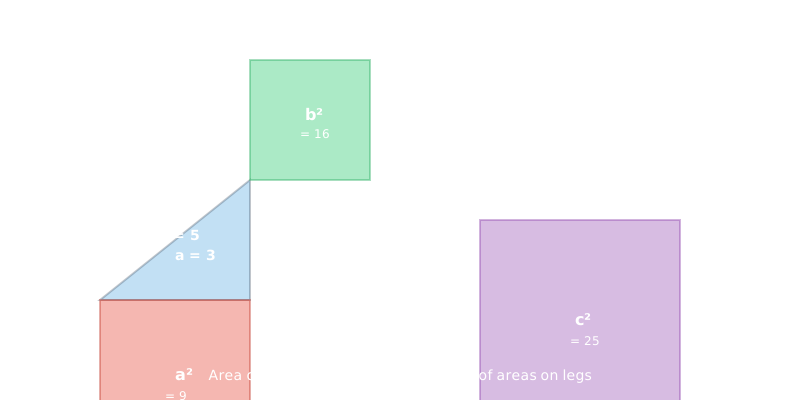
Key Insight: The area of the square on the hypotenuse equals the sum of areas on the two legs:
$$\text{Area}(c^2) = \text{Area}(a^2) + \text{Area}(b^2)$$
This isn’t just symbolic—you can literally cut and rearrange the smaller squares to fill the larger one!
Precise Definition
Theorem 3.1 (Pythagorean Theorem).
In a right triangle with legs of lengths $a$ and $b$, and hypotenuse of length $c$:
$$a^2 + b^2 = c^2$$
Converse (Theorem 3.2).
If three sides of a triangle satisfy $a^2 + b^2 = c^2$, then the triangle is a right triangle with hypotenuse $c$.
Why These Definitions
Why Squares of Sides?
Geometric Reason: Squares are natural area measurements in Euclidean geometry.
Algebraic Reason: Powers of 2 appear naturally in:
- Distance formulas: $d^2 = \Delta x^2 + \Delta y^2$
- Variance: $\sigma^2 = E[(X - \mu)^2]$
- Least squares: minimize $\sum (y_i - \hat{y}_i)^2$
Physical Reason: Energy scales with square of velocity: $E = \frac{1}{2}mv^2$
Why Only Right Triangles?
The perpendicularity (90° angle) is essential. For other angles:
Law of Cosines (generalizes Pythagorean theorem): $$c^2 = a^2 + b^2 - 2ab\cos C$$
- When $C = 90°$: $\cos 90° = 0$, so $c^2 = a^2 + b^2$ (Pythagorean!)
- When $C < 90°$ (acute): $\cos C > 0$, so $c^2 < a^2 + b^2$
- When $C > 90°$ (obtuse): $\cos C < 0$, so $c^2 > a^2 + b^2$
Key Properties
Pythagorean Triples
Definition: Integer solutions to $a^2 + b^2 = c^2$.
Common Examples:
| $a$ | $b$ | $c$ | Verification |
|---|---|---|---|
| 3 | 4 | 5 | $9 + 16 = 25$ ✓ |
| 5 | 12 | 13 | $25 + 144 = 169$ ✓ |
| 8 | 15 | 17 | $64 + 225 = 289$ ✓ |
| 7 | 24 | 25 | $49 + 576 = 625$ ✓ |
Property: If $(a, b, c)$ is a triple, so is $(ka, kb, kc)$ for any $k > 0$.
Connection to Distance Formula
The distance between $(x_1, y_1)$ and $(x_2, y_2)$ follows from applying Pythagorean theorem:
     (x₂,y₂)
        /|
     d / |
      /  | |y₂-y₁|
     /   |
    /____|
 (x₁,y₁)
   |x₂-x₁|
By Pythagoras: $$d^2 = (x_2 - x_1)^2 + (y_2 - y_1)^2$$
Therefore: $$d = \sqrt{(x_2 - x_1)^2 + (y_2 - y_1)^2}$$
This generalizes to $n$ dimensions!
Main Theorems (Multiple Proofs)
Proof 1: Rearrangement (Most Intuitive)
Setup: Square of side $(a + b)$ containing four copies of the triangle.
Area calculation (two methods):
Method 1: Outer square
$$A_{\text{outer}} = (a + b)^2 = a^2 + 2ab + b^2$$
Method 2: Four triangles + inner square
$$A_{\text{triangles + inner}} = 4 \cdot \frac{1}{2}ab + c^2 = 2ab + c^2$$
Equating: $$a^2 + 2ab + b^2 = 2ab + c^2$$ $$a^2 + b^2 = c^2 \quad \square$$
Proof 2: Similarity (Geometric)
Setup: Drop altitude from right angle to hypotenuse, dividing it into segments $p$ and $q$ where $p + q = c$.
Key observation: Creates three similar triangles:
- Original: legs $a, b$, hypotenuse $c$
- Left sub-triangle
- Right sub-triangle
From similarity: $$\frac{a}{c} = \frac{p}{a} \Rightarrow a^2 = cp$$ $$\frac{b}{c} = \frac{q}{b} \Rightarrow b^2 = cq$$
Adding: $$a^2 + b^2 = cp + cq = c(p + q) = c \cdot c = c^2 \quad \square$$
Proof 3: Coordinate Geometry
Setup: Place right angle at origin, legs along axes.
Coordinates: $O = (0, 0)$, $A = (a, 0)$, $B = (0, b)$
Distance from $A$ to $B$: $$c = \sqrt{(0 - a)^2 + (b - 0)^2} = \sqrt{a^2 + b^2}$$
Squaring: $$c^2 = a^2 + b^2 \quad \square$$
Computational Methods
Finding the Third Side
import math

def pythagorean_solve(a=None, b=None, c=None):
    """
    Solve for missing side of right triangle.

    Args:
        a, b: legs (one may be None)
        c: hypotenuse (may be None)

    Returns:
        float: the missing side

    Raises:
        ValueError: if not exactly one side is unknown

    Examples:
        >>> pythagorean_solve(b=4, c=5)  # find a
        3.0
        >>> pythagorean_solve(a=3, b=4)  # find c
        5.0
    """
    unknown_count = sum(x is None for x in [a, b, c])
    if unknown_count != 1:
        raise ValueError("Exactly one side must be unknown")

    if a is None:
        if c <= b:
            raise ValueError("Hypotenuse must be longest side")
        return math.sqrt(c**2 - b**2)
    elif b is None:
        if c <= a:
            raise ValueError("Hypotenuse must be longest side")
        return math.sqrt(c**2 - a**2)
    else:  # c is None
        return math.sqrt(a**2 + b**2)

# Example usage
print(f"3-4-?: {pythagorean_solve(a=3, b=4)}")  # 5.0
print(f"5-?-13: {pythagorean_solve(a=5, c=13)}")  # 12.0
Generating Pythagorean Triples
Euclid’s Formula: For integers $m > n > 0$:
$$a = m^2 - n^2, \quad b = 2mn, \quad c = m^2 + n^2$$
generates all primitive triples (where $\gcd(a,b,c) = 1$).
def generate_pythagorean_triples(max_c, primitive_only=True):
    """
    Generate Pythagorean triples up to max hypotenuse.

    Args:
        max_c: maximum hypotenuse value
        primitive_only: if True, only primitive triples

    Returns:
        list of (a, b, c) tuples

    Examples:
        >>> triples = generate_pythagorean_triples(30)
        >>> (3, 4, 5) in triples
        True
    """
    triples = []
    m = 2
    while m**2 + 1 <= max_c:
        for n in range(1, m):
            a = m**2 - n**2
            b = 2 * m * n
            c = m**2 + n**2

            if c > max_c:
                break

            # Ensure a < b for consistency
            if a > b:
                a, b = b, a

            if primitive_only:
                triples.append((a, b, c))
            else:
                # Add multiples
                k = 1
                while k * c <= max_c:
                    triples.append((k*a, k*b, k*c))
                    k += 1
        m += 1

    return sorted(set(triples), key=lambda t: t[2])

# Generate triples with c ≤ 30
for a, b, c in generate_pythagorean_triples(30):
    print(f"({a}, {b}, {c}): {a}² + {b}² = {a**2} + {b**2} = {a**2+b**2} = {c}² = {c**2}")
Examples Progression
Example 1: Simplest (3-4-5)
Given: Right triangle with legs 3 and 4
Find: Hypotenuse
Solution: $$c = \sqrt{3^2 + 4^2} = \sqrt{9 + 16} = \sqrt{25} = 5$$
Verification: $3^2 + 4^2 = 9 + 16 = 25 = 5^2$ ✓
Example 2: Standard (Missing Leg)
Given: Right triangle with leg 5 and hypotenuse 13
Find: Other leg
Solution: $$b = \sqrt{13^2 - 5^2} = \sqrt{169 - 25} = \sqrt{144} = 12$$
Verification: $5^2 + 12^2 = 25 + 144 = 169 = 13^2$ ✓
Note: This is the 5-12-13 Pythagorean triple!
Example 3: 3D Distance
Given: Points $A(1, 2, 3)$ and $B(4, 6, 8)$ in space
Find: Distance
Method: Apply Pythagorean theorem twice:
Step 1: Distance in $xy$-plane: $$d_{xy} = \sqrt{(4-1)^2 + (6-2)^2} = \sqrt{9 + 16} = 5$$
Step 2: Add $z$-component: $$d = \sqrt{d_{xy}^2 + (8-3)^2} = \sqrt{25 + 25} = \sqrt{50} = 5\sqrt{2}$$
Direct formula: $$d = \sqrt{(4-1)^2 + (6-2)^2 + (8-3)^2} = \sqrt{9 + 16 + 25} = 5\sqrt{2}$$
Example 4: Edge Case (Degenerate)
Given: “Triangle” with sides 0, 4, 4
Check: $0^2 + 4^2 = 0 + 16 = 16 = 4^2$ ✓
Interpretation: Degenerate case—the two legs are collinear (form a straight line). The “triangle” is actually a line segment of length 4.
Example 5: Non-Example (Obtuse Triangle)
Given: Triangle with sides 3, 4, 6
Check: $3^2 + 4^2 = 9 + 16 = 25$ but $6^2 = 36$
Result: $25 \neq 36$, so NOT a right triangle.
Analysis: $25 < 36 \Rightarrow$ obtuse triangle (angle opposite longest side > 90°)
Law of Cosines: $c^2 = a^2 + b^2 - 2ab\cos C$ $$36 = 9 + 16 - 2(3)(4)\cos C$$ $$36 = 25 - 24\cos C$$ $$\cos C = -\frac{11}{24} < 0$$
Since $\cos C < 0$, we have $C > 90°$ (obtuse).
Common Pitfalls
Connections
Prerequisites
- Axioms (@sec-axioms): Geometric foundations
- Distance (@sec-distance): Measuring lengths
- Congruence (coming): Proving triangles equal
This Concept Enables
Immediate Applications:
- Distance Formula: Direct application
- Trigonometry: Foundation for trig functions
- Circles: Computing chord lengths, tangent properties
Advanced Topics:
- Euclidean Norm (Linear Algebra): $|\mathbf{x}| = \sqrt{x_1^2 + \cdots + x_n^2}$
- Arc Length (Calculus): $s = \int \sqrt{1 + (f’)^2} , dx$
- 3D Geometry: Spatial distances and vectors
ML Applications
Distance Metrics:
# Euclidean distance (L₂ norm)
def l2_norm(x):
    return np.sqrt(np.sum(x**2))  # Direct application!

# Used in:
# - k-NN classification
# - k-Means clustering
# - Gaussian RBF kernel
Gradient Magnitude: $$|\nabla f| = \sqrt{\left(\frac{\partial f}{\partial x}\right)^2 + \left(\frac{\partial f}{\partial y}\right)^2 + \cdots}$$
Regularization (L₂ penalty): $$\text{Loss} = \text{MSE} + \lambda |\theta|2^2 = \text{MSE} + \lambda \sum{i=1}^n \theta_i^2$$
Neural Network Initialization:
Xavier/He initialization scales weights by $\frac{1}{\sqrt{n}}$ where $n$ = number of inputs. This comes from variance calculations using Pythagorean-style sums!
Historical Note
Proof #371: Yes, there really are over 370 known proofs! See The Pythagorean Proposition by Elisha Loomis (1927) for a collection of 371 proofs.
Most unusual: President James A. Garfield’s proof (1876) using trapezoid area.
Lean Formalization
import Mathlib.Geometry.Euclidean.Basic

-- Pythagorean theorem statement
theorem pythagoras {a b c : ℝ} (h : RightTriangle a b c) :
  c^2 = a^2 + b^2 := by
  sorry  -- Proof omitted

-- Converse
theorem pythagoras_converse {a b c : ℝ}
  (h : c^2 = a^2 + b^2) :
  RightTriangle a b c := by
  sorry

-- Application: distance formula
theorem distance_formula (p q : ℝ × ℝ) :
  dist p q = Real.sqrt ((p.1 - q.1)^2 + (p.2 - q.2)^2) := by
  -- Follows from Pythagorean theorem
  sorry