Euclidean Geometry
Introduction
Euclidean geometry forms the spatial reasoning foundation essential for machine learning. From understanding projections in high-dimensional spaces to grasping optimization landscapes, these concepts are fundamental prerequisites.
- Vector Spaces: Geometric objects with distance and angles
- Optimization: Gradient descent as geometric motion
- Dimensionality Reduction: Projections preserve geometric structure
- Kernel Methods: Distance-based similarity in feature space
- Neural Networks: Each layer performs geometric transformation
0 Axioms and Postulates
“The laws of nature are but the mathematical thoughts of God.” — Euclid
0.1 Motivation & Context
0.1.1 Historical Setting
In 3rd century BCE Alexandria, Euclid faced a challenge: how to organize all known geometry into a logical system? Rather than present thousands of disconnected facts, he identified a minimal set of self-evident truths from which everything else could be derived.
This revolutionary approach: - Established the axiomatic method still used in mathematics - Influenced formal logic and computer science - Demonstrated that complex knowledge can be built from simple foundations
0.1.2 The Problem
Without axioms, we face infinite regress: - To prove theorem A, we need theorem B - To prove theorem B, we need theorem C - To prove theorem C, we need theorem D… - Where does it end?
Euclid’s solution: Start with statements so obvious they need no proof.
0.1.3 Modern Relevance
In ML/CS: - Programming languages have axioms (basic operations) - Formal verification systems use axiomatic foundations - Type theory builds on logical axioms - Probabilistic reasoning starts with probability axioms
Key Insight: Complex systems require foundational assumptions. The art is choosing the minimal sufficient set.
0.2 Intuitive Picture
Think of axioms as the “rules of the game” for geometry:
Point → GPS coordinate (location, no size)
Line → Stretched string (shortest path)
Plane → Infinite tabletop (flat surface)
Distance → Measuring tape result
Mental Model: You have an infinite blank canvas and two tools: 1. Unmarked straightedge (draw lines) 2. Compass (draw circles)
The axioms tell you: - What operations are allowed - What properties are guaranteed - What you can assume without proof
Close your eyes. Imagine two dots floating in space. Now imagine the shortest path between them. That path is unique—this is Postulate 1’s intuitive content.
0.3 Precise Definitions
0.3.1 Undefined Terms
Three concepts are primitive (undefined, but understood intuitively):
Point: An object with no dimensions (position only)
Line: A one-dimensional object extending infinitely in both directions
Plane: A two-dimensional flat surface extending infinitely
Why undefined? To avoid circular definitions. These are our starting vocabulary.
0.3.2 Euclid’s Five Postulates
Postulate 1 (Uniqueness of Line).
Given any two distinct points \(P\) and \(Q\), there exists exactly one line \(\ell\) passing through both.
Postulate 2 (Line Extension).
Any line segment can be extended indefinitely in both directions to form a line.
Postulate 3 (Circle Construction).
Given any point \(C\) (center) and any positive distance \(r\) (radius), there exists a circle with center \(C\) and radius \(r\).
Postulate 4 (Right Angle Congruence).
All right angles are congruent to one another.
Postulate 5 (Parallel Postulate).
Given a line \(\ell\) and a point \(P\) not on \(\ell\), there exists exactly one line through \(P\) parallel to \(\ell\).
0.3.3 Common Notions (Axioms of Equality)
CN1 (Transitivity). If \(a = b\) and \(b = c\), then \(a = c\).
CN2 (Addition). If \(a = b\) and \(c = d\), then \(a + c = b + d\).
CN3 (Subtraction). If \(a = b\) and \(c = d\), then \(a - c = b - d\).
CN4 (Coincidence). Things that coincide are equal.
CN5 (Whole vs Part). The whole is greater than any proper part.
0.4 Why These Definitions
0.4.1 Why These Specific Five Postulates?
Postulates 1-4: Relatively “obvious” - Can verify locally with physical tools - Match immediate intuition - Universally accepted
Postulate 5: Controversial! - Cannot verify by direct observation (requires infinite extension) - More complex statement - Led to 2000 years of attempted proofs
0.4.2 Why Is Postulate 5 Special?
It’s the only postulate that: 1. Requires infinity: Must extend lines infinitely to verify 2. Determines curvature: Characterizes flat (Euclidean) space 3. Is independent: Cannot be derived from Postulates 1-4
Historical Impact: Attempts to prove Postulate 5 from 1-4 ultimately led to: - Hyperbolic geometry (Lobachevsky, Bolyai) - Elliptic geometry (Riemann) - General relativity (Einstein)
0.4.3 Why Axioms of Equality?
These establish logical consistency: - Enable substitution in proofs - Allow algebraic manipulation - Provide ordering relations
Without them, we couldn’t reason about relationships between measurements.
0.5 Key Properties
From these axioms, immediate consequences follow:
Property 1 (Uniqueness). Given specific conditions, geometric objects are uniquely determined: - Two points → one line - Center + radius → one circle - Line + external point → one parallel
Property 2 (Existence). Geometric objects can always be constructed: - Lines can be drawn and extended - Circles always exist for any radius - Intersections occur (when not parallel)
Property 3 (Consistency). No contradictions arise: - Equality is transitive and symmetric - Measurements can be compared - Whole > Part establishes order
0.6 Main Theorems
These axioms enable us to prove everything else:
Theorem 1.1 (Vertical Angles).
When two lines intersect, vertical angles are congruent.
Theorem 1.2 (Triangle Angle Sum).
The sum of interior angles in any triangle equals 180°.
Theorem 1.3 (SSS Congruence).
Triangles with three pairs of congruent sides are congruent.
Theorem 1.4 (Pythagorean Theorem).
In a right triangle: \(a^2 + b^2 = c^2\).
Theorem 1.5 (Parallel Line Properties).
When a transversal crosses parallel lines, corresponding angles are congruent.
All of these follow logically from the five postulates!
0.7 Computational Methods
0.7.1 How to Use Axioms in Proofs
Standard Proof Structure:
Given: [What we know]
Prove: [What we want to show]
Proof:
  1. [Statement]     [Reason: Given/Axiom/Previous theorem]
  2. [Statement]     [Reason: ...]
  ...
  n. [Conclusion]    [Reason: ...]  ∎
Example: Prove base angles of isosceles triangle are equal.
Given: △ABC with AB = AC
Prove: ∠B = ∠C

Proof:
  1. Draw angle bisector AD from A to BC     [Construction]
  2. ∠BAD = ∠CAD                             [Definition of angle bisector]
  3. AB = AC                                  [Given]
  4. AD = AD                                  [Reflexive property]
  5. △ABD ≅ △ACD                             [SAS congruence]
  6. ∠B = ∠C                                  [CPCTC]  ∎
0.7.2 Verification Algorithm
To check if a proof is valid:
def verify_proof(proof_steps):
    """
    Verify each step cites proper justification.

    Returns: True if valid, False otherwise
    """
    known_facts = set(['given_facts', 'axioms', 'postulates'])

    for step in proof_steps:
        reason = step.reason
        if reason in ['Given', 'Axiom', 'Postulate']:
            known_facts.add(step.statement)
        elif reason in known_facts:
            known_facts.add(step.statement)
        else:
            return False  # Invalid step

    return proof_steps[-1].statement == 'desired_conclusion'
0.8 Examples Progression
0.8.1 Example 1: Simplest Application
Given: Points \(A\) and \(B\)
Question: How many lines pass through both?
Solution: By Postulate 1, exactly one line passes through any two distinct points.
Verification: Try to draw two different lines through both points—impossible!
0.8.2 Example 2: Standard Application
Given: Line \(\ell: y = 2x + 1\) and point \(P(3, 4)\) not on \(\ell\)
Question: How many lines through \(P\) parallel to \(\ell\)?
Solution:
By Postulate 5 (Parallel Postulate), exactly one line through \(P\) is parallel to \(\ell\).
Finding it: Parallel lines have equal slopes.
Slope of \(\ell = 2\), so parallel line: \(y - 4 = 2(x - 3)\), i.e., \(y = 2x - 2\).
Verification:
- Passes through \(P\): \(4 = 2(3) - 2 = 4\) ✓ - Same slope as \(\ell\): Both have \(m = 2\) ✓ - Therefore parallel ✓
0.8.3 Example 3: Edge Case
Given: Point \(P\) on line \(\ell\)
Question: How many lines through \(P\) parallel to \(\ell\)?
Answer: Zero!
Why: The parallel postulate requires \(P\) not be on \(\ell\). A line cannot be parallel to itself—by definition, parallel lines don’t intersect.
Common Error: Thinking “a line is parallel to itself” (incorrect definition).
0.8.4 Example 4: Non-Example (Different Geometry)
Context: Geometry on a sphere’s surface
Setup: Great circles (like equators) act as “lines”
Observation: Through a point \(P\) not on great circle \(\ell\): - Zero parallel lines exist! - All great circles eventually intersect
Conclusion: This is spherical (elliptic) geometry, not Euclidean. Postulate 5 fails on spheres.
Significance: Shows Postulate 5 is truly necessary for Euclidean geometry.
0.9 Common Pitfalls
0.10 Connections
0.10.1 Prerequisites
Domain 0: Foundations - Logic & Proof: Understanding of logical inference (\(\Rightarrow\), \(\Leftrightarrow\), \(\forall\), \(\exists\)) - Set Theory: Points as elements, lines as sets of points
Cognitive Prerequisites: - Spatial reasoning ability - Abstract thinking - Comfort with logical arguments
0.10.2 This Concept Enables
Within Domain 2 (Geometry): - All subsequent geometric theorems - Coordinate geometry (not yet covered) - Trigonometry (not yet covered)
Other Domains: - Domain 5 (Linear Algebra): Vector spaces as geometric objects - Domain 7 (Real Analysis): Metric spaces generalize distance - Domain 9 (Optimization): Geometric interpretation of convexity
0.10.4 Lean Formalization
-- Axiom 1: Two points determine a unique line
axiom point_line_incidence (P Q : Point) (h : P ≠ Q) :
  ∃! ℓ : Line, P ∈ ℓ ∧ Q ∈ ℓ

-- Axiom 5: Parallel postulate
axiom parallel_postulate (ℓ : Line) (P : Point) (h : P ∉ ℓ) :
  ∃! m : Line, P ∈ m ∧ parallel m ℓ

-- Theorem: Vertical angles are equal
theorem vertical_angles_equal (α β : Angle)
  (h : vertical α β) : α = β := by
  sorry  -- Proof would follow from axioms
1 Distance and Angle Measurement
1.1 Motivation & Context
1.1.1 Why Precise Measurement Matters
Ancient Applications: - Egypt (3000 BCE): Re-surveying land after Nile floods - Greece (500 BCE): Navigation and astronomy - Construction: Building pyramids, temples (precise angles crucial)
Modern Applications: - Machine Learning: Distance defines similarity - Physics: Spacetime geometry - Computer Graphics: Rendering 3D scenes - Robotics: Path planning and localization
1.1.2 The Core Problem
How do we quantify “how far apart” two objects are?
Intuitive notions break down: - “Close” vs “far” is subjective - Different paths give different lengths - Need mathematical precision
1.1.3 Historical Breakthrough
Pythagoras (c. 500 BCE) discovered the relationship in right triangles that enables distance calculation in coordinates:
\[d^2 = (\Delta x)^2 + (\Delta y)^2\]
This formula underlies all distance calculations in ML!
1.2 Intuitive Picture
1.2.1 Distance
Physical Analogy: Measuring tape stretched taut between two points.
Key Properties: - Always positive (or zero if points coincide) - Symmetric: distance from A to B equals B to A - Triangle inequality: Direct path is shortest
Mental Image:
    B
   /|
  / |
 /  | vertical
/   | distance
-----
 horiz
 dist
A
The straight-line distance is the hypotenuse.
1.2.2 Angle
Physical Analogy: Amount of “turning” between two directions.
Examples: - Clock hands: 12→3 is 90° (quarter turn) - Compass: North→East is 90° - Steering wheel: Amount of rotation
Mental Image: Angle = opening between two rays.
1.3 Precise Definitions
1.3.1 Distance (Euclidean Metric)
Definition 2.1 (Distance in \(\mathbb{R}^2\)).
The distance between points \(A(x_1, y_1)\) and \(B(x_2, y_2)\) is:
\[d(A, B) = \sqrt{(x_2 - x_1)^2 + (y_2 - y_1)^2}\]
Generalization to \(\mathbb{R}^n\):
\[d(\mathbf{x}, \mathbf{y}) = \sqrt{\sum_{i=1}^n (y_i - x_i)^2} = \|\mathbf{y} - \mathbf{x}\|_2\]
Metric Properties: For all points \(A, B, C\):
- Positivity: \(d(A,B) \geq 0\), with equality iff \(A = B\)
- Symmetry: \(d(A,B) = d(B,A)\)
- Triangle Inequality: \(d(A,C) \leq d(A,B) + d(B,C)\)
1.3.2 Angle Measurement
Definition 2.2 (Angle).
An angle is formed by two rays sharing a common endpoint (vertex).
Units: - Degrees: Full circle = 360° - Radians: Full circle = \(2\pi\) rad - Gradians: Full circle = 400 grad (rarely used)
Conversion: \[\theta_{\text{rad}} = \theta_{\text{deg}} \times \frac{\pi}{180}\]
Definition 2.3 (Angle Classification).
| Type | Measure | Visual |
|---|---|---|
| Acute | \(0° < \theta < 90°\) | Sharp |
| Right | \(\theta = 90°\) | L-shape |
| Obtuse | \(90° < \theta < 180°\) | Wide |
| Straight | \(\theta = 180°\) | Line |
| Reflex | \(180° < \theta < 360°\) | More than straight |
1.4 Why These Definitions
1.4.1 Why the Square Root Formula?
The distance formula derives from the Pythagorean theorem:
     B(x₂,y₂)
        /|
     d / |
      /  | Δy
     /   |
    /____|
  A(x₁,y₁)
     Δx
By Pythagoras on the right triangle: \[d^2 = (\Delta x)^2 + (\Delta y)^2\]
Taking the square root gives the distance formula.
Why squared terms? - Makes distance always positive - Satisfies triangle inequality - Emerges naturally from inner products in linear algebra
1.4.2 Why Radians as the “Natural” Unit?
Radians defined by: \[\theta = \frac{s}{r}\]
where \(s\) = arc length, \(r\) = radius.
Advantages: 1. Calculus works cleanly: \(\frac{d}{dx}\sin x = \cos x\) (only in radians!) 2. Taylor series simple: \(\sin x = x - \frac{x^3}{6} + \frac{x^5}{120} - \cdots\) 3. Arc length formula: \(s = r\theta\) (direct, no conversion) 4. Natural units: \(\theta = 1\) rad means arc length equals radius
Degrees are arbitrary: 360° chosen by Babylonians (base-60 system, divisibility).
1.5 Key Properties
1.5.1 Properties of Distance
Theorem 2.1 (Distance Invariance).
Distance is invariant under: - Translation: Shifting all points by same vector - Rotation: Rotating entire figure - Reflection: Mirroring across a line
This is what makes distance a fundamental geometric quantity—it doesn’t depend on coordinate system choice.
Proof sketch (Translation):
If we shift \(A \to A'\) and \(B \to B'\) by vector \(\mathbf{v}\): \[d(A', B') = \|(B + \mathbf{v}) - (A + \mathbf{v})\| = \|B - A\| = d(A, B)\]
1.5.2 Properties of Angles
Theorem 2.2 (Angle Addition).
If ray \(\overrightarrow{OB}\) lies between \(\overrightarrow{OA}\) and \(\overrightarrow{OC}\): \[\angle AOC = \angle AOB + \angle BOC\]
Theorem 2.3 (Vertical Angles).
When two lines intersect, vertical angles are congruent.
    \ α /
     \|/
  ----+---- β
     /|\
    / γ \
Proof: \(\alpha + \beta = 180°\) and \(\beta + \gamma = 180°\) (linear pairs)
Therefore \(\alpha = \gamma\) (both equal \(180° - \beta\)). \(\square\)
1.6 Main Theorems
Theorem 2.4 (Angle Sum in Triangle).
The sum of interior angles in any triangle is 180°.
Theorem 2.5 (Exterior Angle Theorem).
An exterior angle of a triangle equals the sum of the two non-adjacent interior angles.
Theorem 2.6 (Perpendicular Distance).
The shortest distance from point \(P\) to line \(\ell\) is the perpendicular distance.
Proof: Any other path from \(P\) to \(\ell\) forms the hypotenuse of a right triangle, which is longer than the leg. \(\square\)
1.7 Computational Methods
1.7.1 Computing Distance
import math

def euclidean_distance(p1, p2):
    """
    Compute Euclidean distance between two points.

    Args:
        p1, p2: tuples (x, y) or lists [x, y]

    Returns:
        float: Euclidean distance

    Examples:
        >>> euclidean_distance((0, 0), (3, 4))
        5.0
        >>> euclidean_distance((1, 2), (4, 6))
        5.0
    """
    return math.sqrt(sum((a - b)**2 for a, b in zip(p1, p2)))

# Vectorized version for numpy
import numpy as np

def distance_numpy(p1, p2):
    """Numpy implementation for efficiency."""
    return np.linalg.norm(np.array(p2) - np.array(p1))

# Distance matrix for multiple points
def pairwise_distances(points):
    """
    Compute all pairwise distances.

    Args:
        points: list of (x, y) tuples

    Returns:
        2D array of distances
    """
    n = len(points)
    distances = np.zeros((n, n))
    for i in range(n):
        for j in range(i+1, n):
            d = euclidean_distance(points[i], points[j])
            distances[i, j] = distances[j, i] = d
    return distances
1.7.2 Computing Angles
From three points \(A\), \(B\), \(C\) (angle at vertex \(B\)):
def angle_from_three_points(A, B, C, degrees=True):
    """
    Compute angle ABC (at vertex B).

    Args:
        A, B, C: tuples (x, y)
        degrees: if True, return degrees; else radians

    Returns:
        float: angle at B

    Examples:
        >>> angle_from_three_points((0,0), (1,0), (1,1))
        90.0
    """
    # Vectors BA and BC
    BA = np.array(A) - np.array(B)
    BC = np.array(C) - np.array(B)

    # Dot product and magnitudes
    dot = np.dot(BA, BC)
    mag_BA = np.linalg.norm(BA)
    mag_BC = np.linalg.norm(BC)

    # Angle from dot product formula
    cos_angle = dot / (mag_BA * mag_BC)
    # Clamp to [-1, 1] to handle numerical errors
    cos_angle = np.clip(cos_angle, -1, 1)
    angle_rad = np.arccos(cos_angle)

    return np.degrees(angle_rad) if degrees else angle_rad
1.8 Examples Progression
1.8.1 Example 1: Simplest
Problem: Find distance between \(A(0, 0)\) and \(B(3, 4)\).
Solution: \[d = \sqrt{(3-0)^2 + (4-0)^2} = \sqrt{9 + 16} = \sqrt{25} = 5\]
Verification: This is the famous 3-4-5 right triangle!
1.8.2 Example 2: Standard
Problem: Find distance between \(A(-2, 3)\) and \(B(1, 7)\) in \(\mathbb{R}^2\).
Solution: \[d = \sqrt{(1-(-2))^2 + (7-3)^2} = \sqrt{3^2 + 4^2} = \sqrt{9 + 16} = 5\]
Observation: Same distance as Example 1—translation doesn’t change distance!
1.8.3 Example 3: Higher Dimension
Problem: Find distance between \(A(1, 2, 3)\) and \(B(4, 6, 8)\) in \(\mathbb{R}^3\).
Solution: \[d = \sqrt{(4-1)^2 + (6-2)^2 + (8-3)^2} = \sqrt{9 + 16 + 25} = \sqrt{50} = 5\sqrt{2}\]
Pattern: Pythagorean theorem extends to any dimension!
1.8.4 Example 4: Edge Case
Problem: Distance between \(A(2, 5)\) and itself.
Solution: \[d = \sqrt{(2-2)^2 + (5-5)^2} = 0\]
Interpretation: Only coincident points have distance 0 (metric axiom).
1.8.5 Example 5: Non-Example (Manhattan Distance)
Context: In a city grid, you can’t walk diagonally through buildings.
Manhattan distance: \(d_1(A, B) = |x_2 - x_1| + |y_2 - y_1|\)
For \(A(0, 0)\), \(B(3, 4)\): - Euclidean: \(d_2 = 5\) - Manhattan: \(d_1 = 7\)
Note: This is a different metric—satisfies metric axioms but uses different formula.
1.9 Common Pitfalls
1.10 Connections
1.10.1 Prerequisites
1.10.2 This Concept Enables
Within Geometry: - Trigonometry (will cover later): Relates angles to distances - Circles (will cover later): Defined by constant distance - Coordinate Geometry: Analytic study of shapes
Other Domains: - Domain 4 (Calculus): Derivatives as rates of distance change - Domain 5 (Linear Algebra): Inner products generalize angles - Domain 7 (Real Analysis): Metric spaces abstract distance
1.10.3 ML Applications
Distance Metrics: - k-NN: Classification by Euclidean distance - k-Means: Clustering minimizes within-cluster distances - Kernel Methods: \(K(\mathbf{x}, \mathbf{y}) = f(\|\mathbf{x} - \mathbf{y}\|)\)
Angle Metrics: - Cosine Similarity: \(\cos \theta = \frac{\mathbf{x} \cdot \mathbf{y}}{\|\mathbf{x}\| \|\mathbf{y}\|}\) - Angular Distance: Used in embeddings (Word2Vec, etc.) - Gradient Direction: Angle of steepest ascent
Optimization: - Gradient: \(\|\nabla f\|\) = magnitude, direction = angle - Line Search: Moving distance along gradient direction - Trust Regions: Constrain step size (distance)
1.10.4 Lean Formalization
import Mathlib.Analysis.NormedSpace.Basic

-- Euclidean distance
def euclidean_dist (x y : ℝ × ℝ) : ℝ :=
  Real.sqrt ((x.1 - y.1)^2 + (x.2 - y.2)^2)

-- Metric properties
theorem dist_nonneg (x y : ℝ × ℝ) :
  0 ≤ euclidean_dist x y := by sorry

theorem dist_sym (x y : ℝ × ℝ) :
  euclidean_dist x y = euclidean_dist y x := by sorry

theorem triangle_ineq (x y z : ℝ × ℝ) :
  euclidean_dist x z ≤ euclidean_dist x y + euclidean_dist y z := by sorry
2 The Pythagorean Theorem
2.1 Motivation & Context
2.1.1 Historical Significance
The Pythagorean theorem is arguably the most important result in elementary mathematics:
Ancient Knowledge: - Babylonians (c. 1800 BCE): Knew Pythagorean triples - Pythagoras (c. 500 BCE): First rigorous proof - Euclid (Elements, Book I, Prop. 47): Geometric proof - China (Zhou Bi Suan Jing, c. 300 BCE): Independent discovery
Over 370 Different Proofs! - Geometric rearrangements - Algebraic derivations - Calculus-based approaches - Even one by U.S. President James Garfield!
2.1.2 Why It Matters
Foundation of: - Distance calculations in coordinates - Trigonometry (sine, cosine, tangent) - Euclidean norm in linear algebra - Spacetime metric in relativity
ML Applications: - Every distance calculation uses this theorem - Regularization: \(\|\theta\|_2^2 = \sum \theta_i^2\) - Gradient magnitude: \(\|\nabla f\| = \sqrt{\sum (\partial f/\partial x_i)^2}\) - Neural network initialization: Xavier scales by \(\sqrt{n}\)
2.2 Intuitive Picture
2.2.1 The Setup
Draw a right triangle with: - Legs: sides \(a\) and \(b\) (forming the right angle) - Hypotenuse: side \(c\) (opposite the right angle, longest side)
2.2.2 Visual Proof Intuition
Build squares on each side:
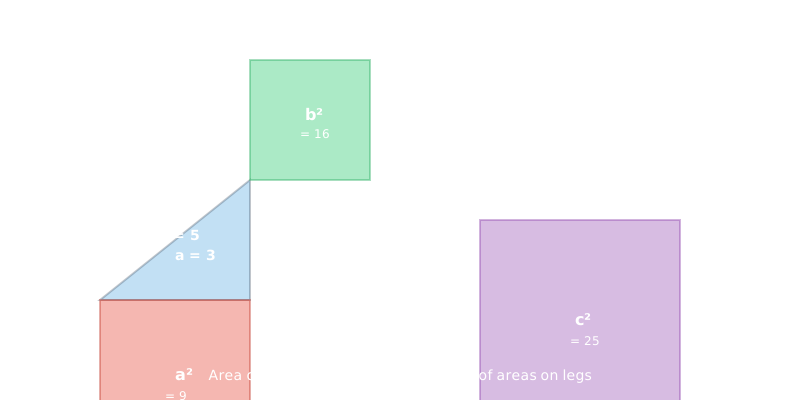
Key Insight: The area of the square on the hypotenuse equals the sum of areas on the two legs:
\[\text{Area}(c^2) = \text{Area}(a^2) + \text{Area}(b^2)\]
This isn’t just symbolic—you can literally cut and rearrange the smaller squares to fill the larger one!
2.3 Precise Definition
Theorem 3.1 (Pythagorean Theorem).
In a right triangle with legs of lengths \(a\) and \(b\), and hypotenuse of length \(c\):
\[a^2 + b^2 = c^2\]
Converse (Theorem 3.2).
If three sides of a triangle satisfy \(a^2 + b^2 = c^2\), then the triangle is a right triangle with hypotenuse \(c\).
2.4 Why These Definitions
2.4.1 Why Squares of Sides?
Geometric Reason: Squares are natural area measurements in Euclidean geometry.
Algebraic Reason: Powers of 2 appear naturally in: - Distance formulas: \(d^2 = \Delta x^2 + \Delta y^2\) - Variance: \(\sigma^2 = E[(X - \mu)^2]\) - Least squares: minimize \(\sum (y_i - \hat{y}_i)^2\)
Physical Reason: Energy scales with square of velocity: \(E = \frac{1}{2}mv^2\)
2.4.2 Why Only Right Triangles?
The perpendicularity (90° angle) is essential. For other angles:
Law of Cosines (generalizes Pythagorean theorem): \[c^2 = a^2 + b^2 - 2ab\cos C\]
- When \(C = 90°\): \(\cos 90° = 0\), so \(c^2 = a^2 + b^2\) (Pythagorean!)
- When \(C < 90°\) (acute): \(\cos C > 0\), so \(c^2 < a^2 + b^2\)
- When \(C > 90°\) (obtuse): \(\cos C < 0\), so \(c^2 > a^2 + b^2\)
2.5 Key Properties
2.5.1 Pythagorean Triples
Definition: Integer solutions to \(a^2 + b^2 = c^2\).
Common Examples: | \(a\) | \(b\) | \(c\) | Verification | |—–|—–|—–|————–| | 3 | 4 | 5 | \(9 + 16 = 25\) ✓ | | 5 | 12 | 13 | \(25 + 144 = 169\) ✓ | | 8 | 15 | 17 | \(64 + 225 = 289\) ✓ | | 7 | 24 | 25 | \(49 + 576 = 625\) ✓ |
Property: If \((a, b, c)\) is a triple, so is \((ka, kb, kc)\) for any \(k > 0\).
2.5.2 Connection to Distance Formula
The distance between \((x_1, y_1)\) and \((x_2, y_2)\) follows from applying Pythagorean theorem:
     (x₂,y₂)
        /|
     d / |
      /  | |y₂-y₁|
     /   |
    /____|
 (x₁,y₁)
   |x₂-x₁|
By Pythagoras: \[d^2 = (x_2 - x_1)^2 + (y_2 - y_1)^2\]
Therefore: \[d = \sqrt{(x_2 - x_1)^2 + (y_2 - y_1)^2}\]
This generalizes to \(n\) dimensions!
2.6 Main Theorems (Multiple Proofs)
2.6.1 Proof 1: Rearrangement (Most Intuitive)
Setup: Square of side \((a + b)\) containing four copies of the triangle.
Area calculation (two methods):
Method 1: Outer square
\[A_{\text{outer}} = (a + b)^2 = a^2 + 2ab + b^2\]
Method 2: Four triangles + inner square
\[A_{\text{triangles + inner}} = 4 \cdot \frac{1}{2}ab + c^2 = 2ab + c^2\]
Equating: \[a^2 + 2ab + b^2 = 2ab + c^2\] \[a^2 + b^2 = c^2 \quad \square\]
2.6.2 Proof 2: Similarity (Geometric)
Setup: Drop altitude from right angle to hypotenuse, dividing it into segments \(p\) and \(q\) where \(p + q = c\).
Key observation: Creates three similar triangles: 1. Original: legs \(a, b\), hypotenuse \(c\) 2. Left sub-triangle
3. Right sub-triangle
From similarity: \[\frac{a}{c} = \frac{p}{a} \Rightarrow a^2 = cp\] \[\frac{b}{c} = \frac{q}{b} \Rightarrow b^2 = cq\]
Adding: \[a^2 + b^2 = cp + cq = c(p + q) = c \cdot c = c^2 \quad \square\]
2.6.3 Proof 3: Coordinate Geometry
Setup: Place right angle at origin, legs along axes.
Coordinates: \(O = (0, 0)\), \(A = (a, 0)\), \(B = (0, b)\)
Distance from \(A\) to \(B\): \[c = \sqrt{(0 - a)^2 + (b - 0)^2} = \sqrt{a^2 + b^2}\]
Squaring: \[c^2 = a^2 + b^2 \quad \square\]
2.7 Computational Methods
2.7.1 Finding the Third Side
import math

def pythagorean_solve(a=None, b=None, c=None):
    """
    Solve for missing side of right triangle.

    Args:
        a, b: legs (one may be None)
        c: hypotenuse (may be None)

    Returns:
        float: the missing side

    Raises:
        ValueError: if not exactly one side is unknown

    Examples:
        >>> pythagorean_solve(b=4, c=5)  # find a
        3.0
        >>> pythagorean_solve(a=3, b=4)  # find c
        5.0
    """
    unknown_count = sum(x is None for x in [a, b, c])
    if unknown_count != 1:
        raise ValueError("Exactly one side must be unknown")

    if a is None:
        if c <= b:
            raise ValueError("Hypotenuse must be longest side")
        return math.sqrt(c**2 - b**2)
    elif b is None:
        if c <= a:
            raise ValueError("Hypotenuse must be longest side")
        return math.sqrt(c**2 - a**2)
    else:  # c is None
        return math.sqrt(a**2 + b**2)

# Example usage
print(f"3-4-?: {pythagorean_solve(a=3, b=4)}")  # 5.0
print(f"5-?-13: {pythagorean_solve(a=5, c=13)}")  # 12.0
2.7.2 Generating Pythagorean Triples
Euclid’s Formula: For integers \(m > n > 0\):
\[a = m^2 - n^2, \quad b = 2mn, \quad c = m^2 + n^2\]
generates all primitive triples (where \(\gcd(a,b,c) = 1\)).
def generate_pythagorean_triples(max_c, primitive_only=True):
    """
    Generate Pythagorean triples up to max hypotenuse.

    Args:
        max_c: maximum hypotenuse value
        primitive_only: if True, only primitive triples

    Returns:
        list of (a, b, c) tuples

    Examples:
        >>> triples = generate_pythagorean_triples(30)
        >>> (3, 4, 5) in triples
        True
    """
    triples = []
    m = 2
    while m**2 + 1 <= max_c:
        for n in range(1, m):
            a = m**2 - n**2
            b = 2 * m * n
            c = m**2 + n**2

            if c > max_c:
                break

            # Ensure a < b for consistency
            if a > b:
                a, b = b, a

            if primitive_only:
                triples.append((a, b, c))
            else:
                # Add multiples
                k = 1
                while k * c <= max_c:
                    triples.append((k*a, k*b, k*c))
                    k += 1
        m += 1

    return sorted(set(triples), key=lambda t: t[2])

# Generate triples with c ≤ 30
for a, b, c in generate_pythagorean_triples(30):
    print(f"({a}, {b}, {c}): {a}² + {b}² = {a**2} + {b**2} = {a**2+b**2} = {c}² = {c**2}")
2.8 Examples Progression
2.8.1 Example 1: Simplest (3-4-5)
Given: Right triangle with legs 3 and 4
Find: Hypotenuse
Solution: \[c = \sqrt{3^2 + 4^2} = \sqrt{9 + 16} = \sqrt{25} = 5\]
Verification: \(3^2 + 4^2 = 9 + 16 = 25 = 5^2\) ✓
2.8.2 Example 2: Standard (Missing Leg)
Given: Right triangle with leg 5 and hypotenuse 13
Find: Other leg
Solution: \[b = \sqrt{13^2 - 5^2} = \sqrt{169 - 25} = \sqrt{144} = 12\]
Verification: \(5^2 + 12^2 = 25 + 144 = 169 = 13^2\) ✓
Note: This is the 5-12-13 Pythagorean triple!
2.8.3 Example 3: 3D Distance
Given: Points \(A(1, 2, 3)\) and \(B(4, 6, 8)\) in space
Find: Distance
Method: Apply Pythagorean theorem twice:
Step 1: Distance in \(xy\)-plane: \[d_{xy} = \sqrt{(4-1)^2 + (6-2)^2} = \sqrt{9 + 16} = 5\]
Step 2: Add \(z\)-component: \[d = \sqrt{d_{xy}^2 + (8-3)^2} = \sqrt{25 + 25} = \sqrt{50} = 5\sqrt{2}\]
Direct formula: \[d = \sqrt{(4-1)^2 + (6-2)^2 + (8-3)^2} = \sqrt{9 + 16 + 25} = 5\sqrt{2}\]
2.8.4 Example 4: Edge Case (Degenerate)
Given: “Triangle” with sides 0, 4, 4
Check: \(0^2 + 4^2 = 0 + 16 = 16 = 4^2\) ✓
Interpretation: Degenerate case—the two legs are collinear (form a straight line). The “triangle” is actually a line segment of length 4.
2.8.5 Example 5: Non-Example (Obtuse Triangle)
Given: Triangle with sides 3, 4, 6
Check: \(3^2 + 4^2 = 9 + 16 = 25\) but \(6^2 = 36\)
Result: \(25 \neq 36\), so NOT a right triangle.
Analysis: \(25 < 36 \Rightarrow\) obtuse triangle (angle opposite longest side > 90°)
Law of Cosines: \(c^2 = a^2 + b^2 - 2ab\cos C\) \[36 = 9 + 16 - 2(3)(4)\cos C\] \[36 = 25 - 24\cos C\] \[\cos C = -\frac{11}{24} < 0\]
Since \(\cos C < 0\), we have \(C > 90°\) (obtuse).
2.9 Common Pitfalls
2.10 Connections
2.10.1 Prerequisites
2.10.2 This Concept Enables
Immediate Applications: - Distance Formula: Direct application - Trigonometry: Foundation for trig functions - Circles: Computing chord lengths, tangent properties
Advanced Topics: - Euclidean Norm (Linear Algebra): \(\|\mathbf{x}\| = \sqrt{x_1^2 + \cdots + x_n^2}\) - Arc Length (Calculus): \(s = \int \sqrt{1 + (f')^2} \, dx\) - 3D Geometry: Spatial distances and vectors
2.10.3 ML Applications
Distance Metrics:
# Euclidean distance (L₂ norm)
def l2_norm(x):
    return np.sqrt(np.sum(x**2))  # Direct application!

# Used in:
# - k-NN classification
# - k-Means clustering
# - Gaussian RBF kernel
Gradient Magnitude: \[\|\nabla f\| = \sqrt{\left(\frac{\partial f}{\partial x}\right)^2 + \left(\frac{\partial f}{\partial y}\right)^2 + \cdots}\]
Regularization (L₂ penalty): \[\text{Loss} = \text{MSE} + \lambda \|\theta\|_2^2 = \text{MSE} + \lambda \sum_{i=1}^n \theta_i^2\]
Neural Network Initialization:
Xavier/He initialization scales weights by \(\frac{1}{\sqrt{n}}\) where \(n\) = number of inputs. This comes from variance calculations using Pythagorean-style sums!
2.10.4 Historical Note
Proof #371: Yes, there really are over 370 known proofs! See The Pythagorean Proposition by Elisha Loomis (1927) for a collection of 371 proofs.
Most unusual: President James A. Garfield’s proof (1876) using trapezoid area.
2.10.5 Lean Formalization
import Mathlib.Geometry.Euclidean.Basic

-- Pythagorean theorem statement
theorem pythagoras {a b c : ℝ} (h : RightTriangle a b c) :
  c^2 = a^2 + b^2 := by
  sorry  -- Proof omitted

-- Converse
theorem pythagoras_converse {a b c : ℝ}
  (h : c^2 = a^2 + b^2) :
  RightTriangle a b c := by
  sorry

-- Application: distance formula
theorem distance_formula (p q : ℝ × ℝ) :
  dist p q = Real.sqrt ((p.1 - q.1)^2 + (p.2 - q.2)^2) := by
  -- Follows from Pythagorean theorem
  sorry
2.11 Interactive Exploration
Use the interactive visualization below to explore the Pythagorean theorem dynamically. Adjust the leg lengths and watch how the squares’ areas relate:
Observations to make: - The equation \(a^2 + b^2 = c^2\) holds for all leg combinations - As you increase \(a\) or \(b\), the hypotenuse \(c\) grows predictably - The visual proof becomes clear: areas on the legs sum to area on hypotenuse
2.12 Practice Problems
2.12.1 Problem 1: Distance Calculation
Given: Points \(A(-3, 2)\) and \(B(5, 8)\) in \(\mathbb{R}^2\)
Find: Distance between \(A\) and \(B\)
Solution (click to reveal)
\[d = \sqrt{(5-(-3))^2 + (8-2)^2} = \sqrt{8^2 + 6^2} = \sqrt{64 + 36} = \sqrt{100} = 10\]
Answer: 10 units2.12.2 Problem 2: Pythagorean Application
Given: A 20-foot ladder leans against a wall. The base is 12 feet from the wall.
Find: Height the ladder reaches on the wall
Solution (click to reveal)
Let \(h\) = height on wall. We have a right triangle with: - Hypotenuse: \(c = 20\) ft (ladder) - Base: \(a = 12\) ft - Height: \(b = h\) ft (unknown)
By Pythagorean theorem: \[12^2 + h^2 = 20^2\] \[144 + h^2 = 400\] \[h^2 = 256\] \[h = 16 \text{ ft}\]
Answer: 16 feet high
Verification: \(12^2 + 16^2 = 144 + 256 = 400 = 20^2\) ✓
Note: This is a multiple of the 3-4-5 triple: \((12, 16, 20) = 4 \times (3, 4, 5)\)2.12.3 Problem 3: Congruence Proof
Given: \(\triangle ABC\) and \(\triangle DEF\) with: - \(AB = 8\), \(BC = 10\), \(CA = 12\)
- \(DE = 8\), \(EF = 10\), \(FD = 12\)
Prove: The triangles are congruent
Solution (click to reveal)
Proof:
- \(AB = DE = 8\) (given)
- \(BC = EF = 10\) (given)
- \(CA = FD = 12\) (given)
- Therefore \(\triangle ABC \cong \triangle DEF\) by SSS (Side-Side-Side) \(\square\)
2.12.4 Problem 4: Non-Right Triangle
Given: Triangle with sides 7, 8, 12
Question: Is this a right triangle? If not, is it acute or obtuse?
Solution (click to reveal)
Check: Does \(7^2 + 8^2 = 12^2\)?
\[49 + 64 = 113 \neq 144\]
So it’s not a right triangle.
Determine acute vs obtuse:
\(7^2 + 8^2 = 113 < 144 = 12^2\)
Since \(a^2 + b^2 < c^2\), the triangle is obtuse (angle opposite longest side > 90°).
Verification with Law of Cosines: \[\cos C = \frac{a^2 + b^2 - c^2}{2ab} = \frac{49 + 64 - 144}{2(7)(8)} = \frac{-31}{112} < 0\]
Since \(\cos C < 0\), we have \(90° < C < 180°\) (obtuse). ✓
Answer: Obtuse triangle2.12.5 Problem 5: 3D Distance
Given: Points \(P(2, -1, 3)\) and \(Q(5, 3, -1)\) in \(\mathbb{R}^3\)
Find: Distance \(PQ\)
Solution (click to reveal)
Apply 3D distance formula: \[d = \sqrt{(x_2-x_1)^2 + (y_2-y_1)^2 + (z_2-z_1)^2}\]
\[d = \sqrt{(5-2)^2 + (3-(-1))^2 + ((-1)-3)^2}\] \[= \sqrt{3^2 + 4^2 + (-4)^2}\] \[= \sqrt{9 + 16 + 16}\] \[= \sqrt{41}\]
Answer: \(\sqrt{41} \approx 6.40\) units
Note: This is NOT a Pythagorean triple (41 is not a perfect square).